Understanding the complexities of departmentalization
On the surface, departmentalization is fairly straightforward; each teacher in a grade is assigned a subject, and teaches that subject to every student in the grade. In reality, scheduling a departmentalized model is slightly more complex because:
- Each teacher must teach the same total number of minutes
- Students have to rotate to every teacher
Therefore, the portion of the school day where departmentalization takes place has to be divided into a number of periods that it is equal to the number of teachers, with all the periods being the same length.
For example: If a grade has 3 homerooms, and the total number of departmentalized minutes is 300 minutes, then each homeroom teacher would need to teach 3 100-minute periods, 1 period for each homeroom.
Exploring Advantages and Trade-offs of a Departmentalized Model
Research is not conclusive on whether or not departmentalization directly leads to improved student outcomes. The decision to departmentalize, then, is likely to rest on school-specific context and factors. In theory, however, departmentalization offers both advantages and tradeoffs:
Potential Advantages:
- Pairing teachers with their strongest content: Allows teachers to focus on relative strengths, meaning that students get instruction from the strongest teacher in each content area; it is important to note that this will require having clear data to support teacher strengths
- Reducing teacher preparation demands: From a teacher perspective, it can reduce workload by limiting the number of different subject areas each teacher is responsible to prepare for
Potential Trade-offs:
- Less flexible scheduling: Because all teachers much teach the same number of minutes, a departmentalized model requires that the instructional day be subdivided into a number of periods that is equal to the number of teachers being departmentalized. Doing this requires retrofitting the desired instructional minutes into a structure that may be inconsistent with instructional priorities
- Lost instructional time: A departmentalized model increases the number of transitions during the school day, which amounts to decreased instructional time
- Inconsistent student experiences across buildings: Because departmentalization is heavily dependent on the number of teachers at each grade level, the resulting scheduling differences across schools may translate into different amounts of instruction for students in each school
- Increased number of students taught by each teacher: While a departmentalized model reduces the number of subjects each teacher prepares to teach, it also typically means that each teacher is teaching more students
Assessing whether conditions are in place for successful departmentalization at each school
Departmentalization may not be successful at every school. The following checklist details some of the conditions that indicate whether departmentalization might be successful:
- Does the school have a strong rationale for why departmentalization would lead to better outcomes for students?
Understanding why a specific school or grade wants to departmentalize is important. In some cases, the motivation may have more to do with teacher preference than student needs. It is important to ensure that the school is confident that departmentalization will lead to better outcomes for students.
- Does student and teacher data for this school indicate clear trends about individual teacher strengths?
Departmentalization may make sense if there is clear evidence that individual teachers have a particular strength in different content areas. For example, if a school is going to assign every student at a particular grade level to a single teacher for reading, they should have compelling evidence that that teacher is the best reading teacher on the team.
- Based on data about teacher strengths, is there a logical way to map instructional content to each teacher that will meet all student needs?
Once a school understands the relative strengths of its teachers and how those align to student needs, it is also important to ensure that these strengths will allow for a logical division of the academic program across the teachers.
Developing a framework for departmentalized instruction
In addition to assessing whether the conditions are in place for departmentalization to be successful at each school, it is important to determine what strategies for subdividing instructional minutes are consistent with the district’s instructional priorities. Identifying a range of options at the district level will help ensure that students receive consistent amounts of instruction in core subjects at all schools.
Step 1. Determine what subjects will be departmentalized
Calculate the total departmentalized minutes by adding all non-departmentalized time and subtracting from the length of the school day.
For example, if the sum of lunch, recess, interventions, and specials add up to 120 minutes, and the school day is 360 minutes, 360 - 120 = 240 minutes of departmentalized instruction.
Step 2. Determine how the instructional minutes will be divided across teachers
Directions:
2a. Determine the number of teachers on each “team”:
The size of the teacher teams is tightly connected to the number of classrooms or sections at each grade level. For example, if a grade level has 4 classrooms, there are only 3 ways that this grade could departmentalize: There could be one team of 4 teachers, 2 teams of 2 teachers, or 1 team of 3 teachers plus 1 teacher who doesn’t departmentalize and teaches all subjects.
2b. Divide the total instructional minutes by the total number of teachers on the team:
Because each teacher has to teach the same amount of time, once you’ve determined how many teachers are on a team, the next step is to divide the instructional minutes evenly among the teachers. This will tell you how long each “block” in the schedule will be.
For example, with 240 minutes of departmentalized instruction, in a 2 teacher team, each teacher will teacher 2 blocks of 120 minutes each, in a 3 teacher team, each teacher will teach 3 blocks of 80 minute each, and in a 4 teacher team, each teacher will teacher 4 blocks of 60 minutes each.
2c. Determine how to allocate instruction across the teacher team
Once the number of teachers and the length of each block has been determined, the final step is to determine which subjects each teacher will be instructing and to schedule the blocks accordingly.
See below for some common team structures examples.
Team structure examples
Two teacher team
Valid for grades with 2, 4, 6, 8, or any even number of sections.
Typically, one teacher teaches ELA and Social Studies while another teaches Math and Science.
Teachers could deliver instruction in a blended model, or have specific periods per subject.
One advantage of specifying each subject time is to protect pull out from reading and math, while allowing pull out during science and social studies to facilitate special education scheduling.
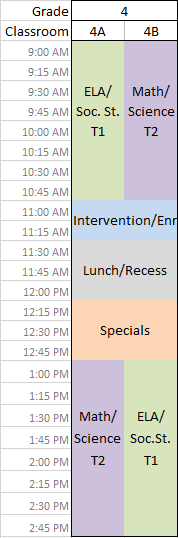
Example 1 - Blended Model. 120m ELA/Soc. Studies, 120m Math/Science.
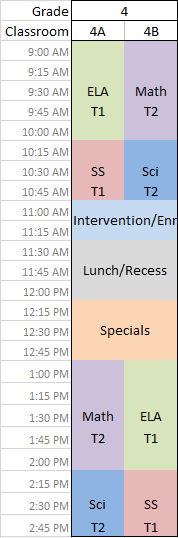
Example 2 - Specific/even blocks. 75m ELA and Math, 45m Social Studies and Science.
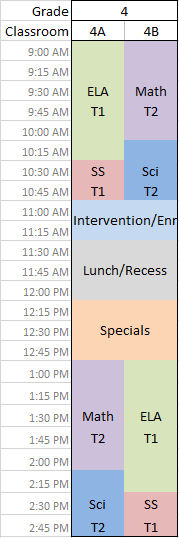
Example 3 - Specific/un-even blocks (allows more balanced subject emphasis).
90m ELA, 75m Math, 45m Science, 30m Social Studies.
Three Teacher Team
Valid for grades with 3, 6, or any multiple of 3 sections.
Typically, one teacher teaches ELA, one teacher teaches Math, and one teaches Science/Social Studies. Of course, other combinations are possible.
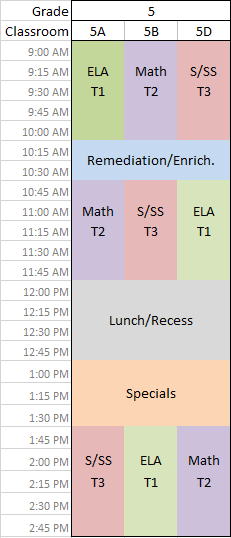
Example 1 - One teacher teachers ELA for 75m, one teacher Math for 75m, and one teaches Science/Social Studies for 75m.
Another option with three sections is to have a two-section team, and a self contained classroom.
In some cases where you have 5 or 7 sections in a grade, you may need to combine teams of 2 and 3. One challenge is to ensure students get the same number of minutes in each subject regardless of the team they are on.
0 Comments